
'With inflationary pressures now at elevated levels and the adverse cost environment persisting, the company has to pass on a portion of the increased costs to the market, while continuing to ensure that the impact on customers is kept to the minimum extent possible.'

On an average most commodities are up between 20-30 per cent compared to a year ago levels.

Escalating geopolitical tensions in West Asia are beginning to disrupt India's automotive supply chain, leading to rising commodity prices, logistics bottlenecks, material shortages, and pressure on consumer demand, with two-wheeler makers already raising prices.

Suzuki Motorcycle India Ltd (SMIPL) has revised its domestic two-wheeler sales growth estimate for FY27 downwards from 7-8 per cent, citing rising commodity costs due to the ongoing West Asia conflict and its impact on consumer affordability.

Rising commodity prices are set to hurt margins of India Inc in the on-going fourth quarter of FY 11, even though revenues are seen higher than the previous year, ratings agency Crisil said on Monday.

The adverse impact on the margins of auto, consumer staples and consumer durables sectors will be counterbalanced by an earnings uptick in the metals, cement and oil & gas sectors.

Net profit of the private sector entities followed a downward trend in third and fourth quarters of 2008-09.

Companies are already diversifying sourcing, raising prices, and reworking operating models as the disruption drags on.

India's wholesale price inflation surged to 8.30 per cent in April, up from 3.88 per cent in March, primarily driven by a significant increase in the prices of fuel, power, and crude petroleum, according to data from the commerce and industry ministry.

The Reserve Bank of India (RBI) has projected a 6.9 per cent GDP growth for the current financial year, citing concerns over commodity prices and supply chain disruptions stemming from the West Asia crisis.
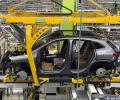
Domestic passenger vehicle dispatches in India rose 25.4 per cent year-on-year to 4,37,312 units in April, continuing the strong demand momentum from the previous fiscal year, according to SIAM.

Investors and companies should brace for higher commodity prices over the next few weeks in the backdrop of Russian troops attacking Ukraine on Thursday. Meanwhile, US President Joe Biden threatened new sanctions against Russia for an act of aggression against Ukraine. All this, analysts believe, can push prices of key commodities such as crude oil, ammonia, urea, potash, and phosphates higher.

Maruti Suzuki India's shares gained over 2.5 per cent after a strong March-quarter performance, with analysts maintaining a positive medium-term outlook driven by buoyant domestic market volumes, capacity expansion, and export growth, despite anticipated near-term margin pressures from higher commodity prices and startup costs.

Mahindra & Mahindra (M&M) is largely bullish among analysts following its Q4FY26 results, driven by strong SUV demand, a robust product pipeline, and improving growth visibility across segments, despite near-term margin pressures from rising commodity costs and potential weakness in the tractor cycle.

Flex fuel motorcycles can deliver "3 per cent higher torque and 7 per cent higher peak power".

Hindustan Unilever (HUL) exceeded consensus estimates in Q4FY26, driven by lower overheads and 6 per cent consolidated volume growth. However, the company anticipates further price hikes to counter an expected 8-10 per cent material cost inflation, while maintaining a mid-term margin guidance of 22.5-23.5 per cent.

'OMCs are incurring losses of Rs 1,000 crore per day due to the West Asia crisis.'

Indian benchmark indices Sensex and Nifty experienced declines due to a sharp rally in crude oil prices, continuous foreign fund outflows, and geopolitical uncertainties. Regulatory developments in the banking sector, particularly the implementation of the Expected Credit Loss (ECL) framework, also contributed to the selling pressure.

Opposition MPs in the Rajya Sabha criticised the Modi government's economic policies, citing the LPG crisis, lack of energy security, and concerns over the Economic Stabilisation Fund.

After the hit of the pandemic, India Inc is now worried about the adverse impact of inflation and higher commodity prices on their revenues and margins. The inflation scare is the strongest among manufacturers of consumer goods such as automobiles, consumer durables, and fast-moving capital goods (FMCG). Companies across sectors fear they will not be able to pass on the hike in input costs to their consumers due to weak demand, which, in turn, would lead to a hit on margins and profitability in the forthcoming quarters.

Richard Heald, Vice-Chairman and Amitabh Malhotra, Director of Rothschild spoke about the volatile market, its implications and how this is an opportunity for Rothschild in India. Heald said that rising commodity prices are worrisome. The inflationary pressures are a concern. He advised that corporates should be open to all financing options. Investors in general want to invest in cash generating assets and commodities. With no decoupling other markets will impact India too.
Commodities prices will witness a major upheaval in the coming couple of years with demand for food going up.

'Once the market decides it wants to go up, it goes up -- no amount of bad news can really hold it back.'

The case for long-term investment in gold, however, remains intact.
S&P Global Ratings has increased India's GDP growth forecast for the next fiscal year to 7.1 per cent, citing private consumption, investment, and exports as key drivers. However, the agency also cautioned that the conflict in the Middle East could strain India's fiscal position due to higher energy prices.

Insights from behavioural economics suggest that an ambitious nudge can be effective if three conditions are met, points out Ram Singh Insights from behavioural economics suggest that an ambitious nudge can be effective if three conditions are met, points out Ram Singh, director, Delhi School of Economics.

The Indian government has restricted industrial, commercial, and institutional users from purchasing petrol and diesel from retail petrol pumps, directing them to bulk sale points instead. This move, which can last up to 90 days, aims to address abnormal demand growth and prevent localised shortages caused by a significant price difference between retail and bulk fuel prices.
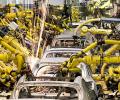
Passenger vehicle sales in India reached a record high of 4.7 million units in FY26, boosted by strong performances from major automakers and the implementation of GST 2.0.

India's leading passenger vehicle manufacturers are significantly increasing investments and factory capacities, alongside planning major product launches for FY27, driven by strong confidence in sustained domestic demand growth despite global geopolitical tensions and supply chain risks.

Live updates on the US-Israel-Iran war: Trump escalates threats, Iran retaliates, and oil prices surge as the Strait of Hormuz crisis disrupts global markets.

India's economy registered a robust 7.7 per cent growth in the fiscal year 2025-26, an increase from 7.1 per cent in the previous year, with the January-March quarter alone seeing a 7.8 per cent expansion.

Prices of key inputs up 44% to 74%; analysts expect earnings squeeze after a quarter or two.

India's exports reached a six-month high, growing by 18 per cent to USD 45.2 billion in May, driven by electronic goods, petroleum products, engineering items, and pharmaceuticals. However, the trade deficit widened to USD 28.21 billion due to a 10 per cent rise in imports, particularly petroleum products and gold, amidst surging crude oil prices.

Headline inflation for March stood at 8.98 per cent, while food inflation was at 8.76 per cent for the week ended April 16.
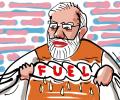
Following through announcements with enforcement of measures is key, as a run through recent Indian economic history shows, points out A K Bhattacharya.

Gold prices experienced a significant decline in futures trading due to uncertainty surrounding geopolitical tensions in West Asia and conflicting statements regarding the conflict. Investors are also awaiting key macroeconomic data for further direction on interest rate cuts.

Indian equity benchmark indices experienced a significant drop in early trade, with the BSE Sensex falling over 525 points and the NSE Nifty down more than 164 points, primarily due to rising crude oil prices and ongoing uncertainty surrounding the US-Iran conflict.

Analysts predict a surge in gold and silver prices as investors seek safe-haven assets due to escalating tensions in the Middle East. The impact on domestic prices will depend on the conflict's duration, with geopolitical factors and macroeconomic data also playing a role.

10 stocks from the Nifty 200 index that offer good growth potential and scope to deliver decent returns from current levels, based on brokerage estimates.

koda Auto Volkswagen India aims to capture a 5 per cent share of India's passenger vehicle market by 2030, driven by new product launches, including alternate fuel vehicles, and a potential entry into the high-volume sub-4 metre SUV segment.
